> I've been on android for a while, so I'm sure I'm biased, but stock AOSP Android is pretty much perfect for me. Very minimal and aesthetically beautiful, but still powerful and customizable.
You can get AOSP on a lot of phones, you just have to be comfortable flashing a custom ROM.
I don't understand why anyone would pay iPhone prices for an Android phone. Even if the hardware quality is similar (which it won't be, because Apple SoCs are at least a generation ahead of everyone else) Android app quality is much worse.
I'm saying this as someone who has only ever used Android.
I just can't see the justification to spending this much money on a phone Google will drop support for after 2 years, in addition to never fixing some issues that are present at launch (look up the Nexus 4 camera reset issue, which Google never fixed).
I'm using a Xiaomi Redmi 2 I picked up new from AliExpress for $125 USD with free shipping to Europe, and I'm running Marshmallow via CM. Works perfectly, in fact most of the time it's better than $300-400 phones thanks to not being loaded to the gills with Google Apps crapware (seriously I have no use for Google Play Music, Books, News, etc)
Edit: for people down voting this, could you explain why? I've left my opinion here and if you disagree with it, I'd love to hear why. I don't believe I've stated anything factually incorrect.
> I just can't see the justification to spending this much money on a phone Google will drop support for after 2 years, in addition to never fixing some issues that are present at launch (look up the Nexus 4 camera reset issue, which Google never fixed).
Plus, you can't just walk into a local Google Store and use the accidental damage insurance to replace your phone on the spot (or repair it within an hour or so) if you dropped it and cracked the screen.
I don't want to mail my phone in to a repair center and be without a phone for a few days. I want it fixed or exchanged in a short time while I wait, and I won't pay iPhone prices for a Pixel phone if I can't get that level of service.
Purchases of high-end items are not motivated merely the items themselves. They are also motivated by the level of service the buyer gets if something goes wrong. For example, if you bring your Toyota to the dealership for service, you'll be lucky to get a loaner car. If you bring your Lexus to the dealership for service, you'll almost certainly get a loaner car that's even nicer than the car you brought in.
If you buy an Apple product, you get a pretty big network of retail stores with free support and fast service turnaround. If you buy a Pixel, what do you get other than the phone itself?
> I don't want to mail my phone in to a repair center and be without a phone for a few days.
FYI: I've been a long time Android user and can tell you that the process works different. And is actually not as bad as you think.
1) You call the hotline, they send you a link via mail
2) Clicking this link will place you in their shop with a promo-code
3) You buy the replacement phone
4) Once you've got the replacement you send in the broken one (or if you feel like it earlier)
5) Once they recieved the broken one, you get a refund on you purchase
Knowing this process so well is the reason I've bought me an iphone 7 now ;-)
I had an HTC One with a defective camera and HTC had no process like this. I would have had to send them the phone and wait.
Verizon helped me out and sent a refurb phone without me having to return my phone first. The refurb camera was even worse.
After that I went iPhone. No reason to pay the same price for Android and get crappy service, especially when the iPhone has resale value. A used Android has no resale value whatsoever.
However, if the Pixel is like other Androids the list price is a joke and carriers will be discounting it shortly.
I wonder if the Pixel will have good resale value. It seems just as well-built as an iPhone, but unless Google changes its update policy, the Pixel won't be able to run new versions of Android after two years. That is a huge drag on resale value.
I don't know about you, but if I was in the market for a used phone, I'd go for one that could run the latest OS.
The Pixel seems to me to be a vindication of the Apple model: controlling both the hardware and software can get you a pretty good product, and in the case of upgrades, you only have to support the hardware that you yourself have released. There is no technical reason Google can't support the Pixel phones for years, like Apple does, but I doubt they will do that.
Indeed, google on promises 2 years. But are typically much more generous. For instance the nexus 5 came out in Oct, 2013. It got marshmallow, but not nougat. I suspect it would have (it has plenty of ram/cpu), but for whatever reason qualcom didn't update the video driver for the snapdragon 800.
If it really bothers you the open bootloader makes it easy to find AOSP built from whatever community that floats your boat.
> If it really bothers you the open bootloader makes it easy to find AOSP built from whatever community that floats your boat.
Or I can buy an iPhone and run the latest software with zero effort.
That is a big difference, especially when you consider that the vast majority of consumers would have to look up the terms "AOSP" and "bootloader" after reading your comment, and even after looking them up, would have no idea what to do.
I should have added that I had this process with multiple nexus devices, thus my "shop" was google. I would expect them to handle the pixel phones the same way.
Yup, get a OnePlus, get a Xiaomi, but what's the gain in going from one of those devices to a Pixel or the latest Samsung or even an iPhone? Pretty much nothing, a different UI, maybe a slightly better camera. It still does almost everything the exact same.
Specs are very often on par (this Pixel is pretty damn close to a OP3, less RAM and less ) and the phones are 40% or more cheaper! It's just plain stupid.
I picked up a used Nexus 6 (in excellent condition) recently, and it is an incredible device. I'm also on the bleeding edge OS-wise, as I get Android Beta/Preview releases.
My primary device is an iPhone 6 Plus, and I have to say, Nexus 6 and Android N is really impressive from both a hardware and software perspective.
That being, I wish Google decoupled device drivers from the Android image.
If they adopted the Windows on PC device driver model, it would be so great for users, especially those with older and less supported phones.
>If they adopted the Windows on PC device driver model, it would be so great for users...
I seriously doubt it. I just changed my broadband provider at home. Our Macs, mobile devices and WDTV connected to the new wifi router immediately, but it took 2 hours to get the Windows laptop to connect to the internet. It found the wifi network fine, but no internet. This has happened before. Googling found dozens of hits for this issue, all with different solutions that worked for different people and each time it's happened to me on the same laptop different solutions have worked, such as: Delete the device in device manager and then scan for new hardware; ipconfig /renew; fiddling with Advanced driver settings.
This time I fixed it by reverting from the Microsoft driver to the vendor provided driver. The last thing we need on our phones is hardware, drivers and OS developed by different companies that don't talk to each other and don't do proper whole-system integration testing on all builds and upgrades.
The battery-conserving mechanisms of Android are not particularly hardware-specific on most devices.
Ideally, Android (or their patched version of the Linux kernel) would expose an API for each different kind of device. An general API for cameras, an API for audio, etc. The manufacturers would then write device drivers that implement / fulfill the functionality of these open/generic APIs. (This is how things are done on PCs.)
Some phones have two CPUs or SoCs, one being energy-efficient and the other highly-performant, and the system switches between them based on the workload. But an update of the OS could simply add & expose an additional new API for dual-SoC systems.
Decoupling device drivers and OS releases would be a huge win for everyone. We'd get the security update swith newer OSes, and even driver updates would be simpler.
PC peripheral manufacturers often release updates to their device drivers, and for a Linux and Windows users its relatively straightforward to update a device driver. E.g., I just updated my Nvidia graphics driver on Linux to the latest version two days ago. I have several kernel modules installed, and apt-get handled everything seamlessly, and built a new kernel image in a jiffy.
How often do you see device drivers updated on Android? Especially if there's a bug, how long before it's fixed? All of the drivers on Android are baked into this giant system image, and the system image contains so many disparate components, that shouldn't all be locked together. The Android system image release process is so broken. The Google -> Manufacturer -> Carrier approval & release is slow and dysfunctional.
The best way to go would be to adopt standard Linux distro practices, use a good package manager (like NixOS) that'll manage and assemble all the disparate system components, instead of shipping one giant frozen-in-time system image.
> The manufacturers would then write device drivers that implement / fulfill the functionality of these open/generic APIs. (This is how things are done on PCs.)
This is not a full picture how things work on PCs. There are also dependencies - i.e. you cannot power down the bus, while the device on the other end is not powered down. Things get more interesting, when you have SoC that implements multiple functions and there are interdependecies, where you would not expect them. The entire problem with Skylake mobile chips is, that nobody knows how to properly change the power states and Intel isn't telling anyone.
Even linux distros are on their way to manage the system in image-like way. See project atomic, or this video: https://youtu.be/XNLPkMDf9LI
Where are you basing this on? Out of some social media apps (Facebook and Snapchat) I have found that Android apps are on-par with their iOS counterparts.
Not the grandparent, but having used Android for years I would argue that's true too. Consider that Android apps are generally even made second for a lot of startups, so in a lot of cases Android forfeits by not even having an app in their ecosystem. Most YC companies are in that boat too--companies that make the iOS version first.
I use both. Currently I have an ipad and an android phone.
Android apps are neglected next to ios. Examples:
* spotify is shit on android. They broke audio playback during system announcements (like google maps directions) and just didn't give a damn for two months. It's not like anybody uses spotify and maps in a car or anything.
* most bank apps on android still don't take advantage of fingerprint auth to avoid typing long bank passwords. Four word passwords with punctuation are super fun to type on mobile.
* fitbit: Until about 6 months ago, pushing back from various subscreens would take you out of the app instead of navigating back to the main screen. There's clearly no-one who matters at fitbit that cares about android. It also doesn't particularly reliably connect to the device. Graphs and data desync from each other. I have not seen this on ios.
* there really isn't any reader on android as nice as GoodReader
* games come second, if ever -- eg kingdom rush frontiers
At the time I bought it, Good Reader's advantages where:
* a full file manager, with folders;
* various ways to get files on and off: a built in web server to upload files, good dropbox integration;
* the ability to crop pdf pages to just the text to get rid of margins so your ipad isn't displaying an inch of whitespace next to the text. Also the ability to set different crop sizes/locations for even and odd pages.
* bookmarks, plus the ability to email them to yourself
* tabbed files, including the ability to open a single file more than once so you can easily switch back and forth between different locations
I haven't kept up with Adobe's Reader, but it has 3 stars while goodreader costs more and continues to get glowing reviews.
I agree with this as an Android user. The lack of device support from Google is appalling. And all my nexus devices (4, 7) have had major hardware flaws that never get fixed - once you're past the warranty, you're SOL. The 7 had many touch screen problems, and a very flimsy charger port (which broke under warranty, then broke again after - so I can't charge it anymore :|).
If you want decent hardware on Android, you have to go with Samsung. But their support for devices is even worse than Google - my Tab S just got Marshmallow. And touchwiz really hurts the Android experience.
Compare to Apple - I still have a first generation iPad that my kids use, and it's still going strong. It's a bit dented, but that thing is a tank.
I match your 1st gen iPad and raise you an iPhone 3GS. My youngest just upgraded to a hand-me-down iPhone 4 a few weeks ago, but my old 3GS is still working fine and even still works with the App Store. I can still download apps on to it that I bought back in 2009 and don't even show up in the store on modern devices, but they're still there for the 3GS. She used it for Whatsapp a lot. Gobsmacked.
I match your iPhone 3GS and raise an 3G. That thing had last iOS release 4.x, which made it unusable and I was scrambling to return it to 3.x. It wasn't capable to download anything from Apple Store for years. It still works as a phone though, also most of the built-in apps work, (except for syncing with Google account, since Google disabled ActiveSync support).
What a difference one year of device age can make.
I had a 3G as well. We got maybe 3 years of useful work out of it, but that's all. It ended up with my wife's sister in China. The 3GS looked the same and seemed like an incremental update, but the improvements made a massive difference. Then the year after they came out with the iPhone 4. Wow! Those 2 years look like 5 years or more worth of advances in retrospect.
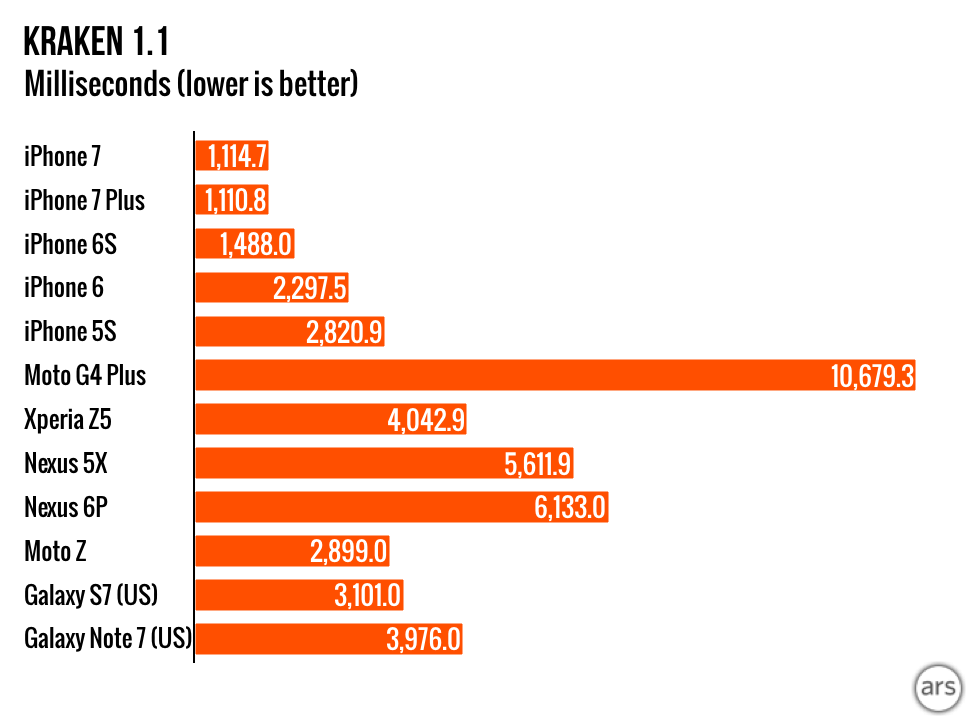
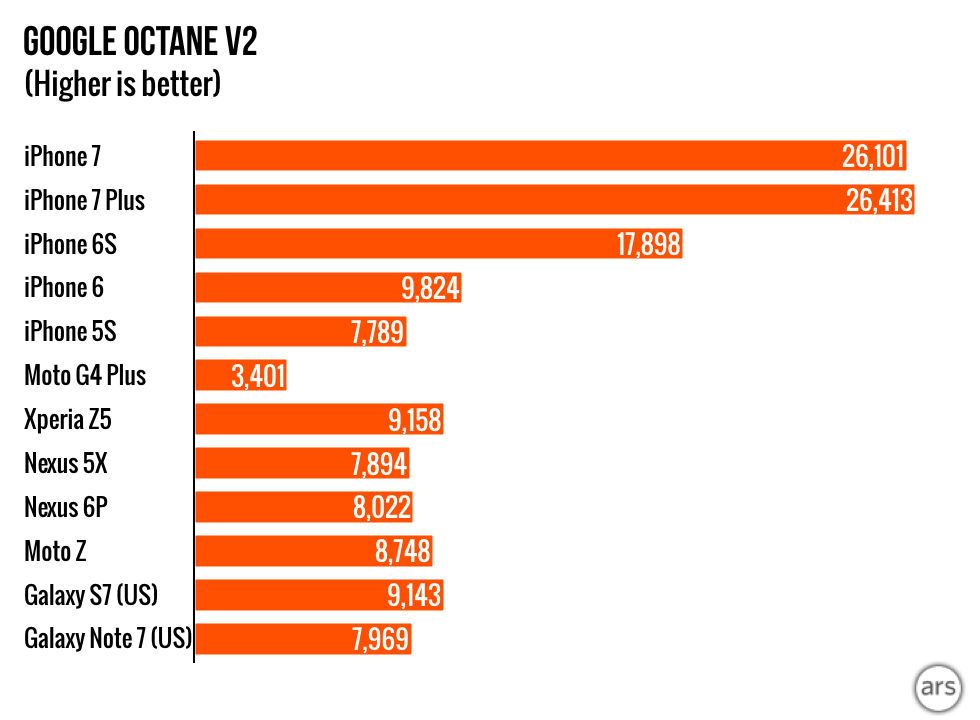
>(which it won't be, because Apple SoCs are at least a generation ahead of everyone else)
Can anyone confirm if this is true? I thought the general advantage for i[a-zA-Z0-9]\+ is a well defined small N number of targets, which allow great optimization. Generally, the parts on apple things are a bit older than the competition but they pull off more (at least in user's eyes) compared with Android due to that optimization.
> the parts on apple things are a bit older than the competition
Not sure where you got that impression, maybe you're thinking about Apple's laptops? Apple get the best and the latest from TSMC, which at the moment is 16nm finfet and next year expected to be 10nm finfet. Intel is the only company with a better process, and they don't make smartphone SoCs. And Apple has hired all the best Austin-based talent for their design team, poaching AMD and others heavily.
Recently, Apple has been about a year ahead. Compare the A9 (which shipped in the 6s in fall 2015) with the Snapdragon 810 (which shipped in the Nexus 6p at the same time).
Especially since there's not much effort from Apple needed to keep the Mac lineup modernized. Intel does much of the work for them.
Apple could just drop new Intel chips into their existing MacBooks as they get released, and easily be getting improved speed + efficiency each year. The new Kaby Lake chips even do hardware 4K video and VP9. http://arstechnica.com/gadgets/2016/08/intel-unveils-kaby-la...
They have a lot more control over the mobile processors. The laptop processors have to maintain compatibility with all the software that people run on their laptops; effectively, that means they're stuck with other people's processors.
That's not really true. x86 emulation is a solved problem at this point, and Apple has shown willingness to use emulation to bridge an ISA transition in the past.
I think the real reason is some combination of (a) ARM isn't competitive (or only recently became competitive) at the high power/high performance point that Intel CPUs excel at; (b) the Mac line generates so much less revenue and operates at so much smaller of a scale than iOS devices that it isn't worth developing CPUs in-house for them, not to mention the fixed costs associated with undergoing a transition.
I guess Apple could 'survive' releasing a new generation of laptops which run slower than the previous ones to facilitate a user-invisible component sourcing decision, but it seems like a bad move.
It'd be temporary and only for third-party apps, not Apple-supplied ones. But yes, I do agree that it's not worth it for them--this is part of what I mean by high fixed costs of switching.
I would - only because of the investment required. Over the past few years, Apple's been very involved in its iOS ecosystem, while investing comparatively little in its Mac lineup.
Dumping Intel chips would take a ton of effort and resources, in an area where Apple isn't interested in making an effort or investing resources.
You're right, it would take a huge investment in effort and resources. You will know they are doing this when you see the Mac lineup sit unchanged for a long time...
Single core performance is still the single most important metric for most users, especially since things like web browsers tend bottleneck on single thread performance and browsing is one of the most common things people use phones for, especially given how commonly native apps use embedded web views.
Measuring browser performance is hard because there's a lot of different functionality but notice how routinely we see reviews where the device the Android flagship phones are trying to beat is the iPhone 6 or even 2013's 5S:
Some of that reflects the considerable amount of work which Apple has put into Mobile Safari but a lot of that is going to come down to single thread performance.
That's why I mentioned embedded web views: a lot of time recorded as native apps involves embedded web-views and these days that means things like JavaScript or layout performance matter more than might be immediately obvious. On iOS, the least involved way to see this is in things like news apps where Safari content blockers also block advertisements in the app.
The other side of this is that we're not really talking about which app has the most time in the foreground so much as which app causes the user to wait the most. Much of that time will be network I/O which is a real challenge but also not relevant to this discussion about CPU performance.
Fundamentally, all I'm trying to say is that Amdahl's law still applies until we're at the point where the user is never waiting on computation. Developers have been getting better at multithreading but uneven CPU usage is still common enough that I'd favor fewer faster cores over more slower cores.
Part of that is not so much just that Apple is "way ahead" as it is that Qualcomm is falling far behind -- and Qualcomm's roadmap is effectively Android's roadmap, for many OEMs.
That Xiaomi Redmi 2 seems to be exactly what I've been looking for. Maybe a little big but I'll take it if it means CM support, replaceable battery and swappable SD card. Any idea if it works on Project Fi? I can't seem to find a definitive answer.
If you aren't aware (I wasn't), xiaomi phones run miui which is somewhat different than stock android. Google miui before you buy. Or you have to be comfortable installing an android distribution.
Really? That's sad to hear, back in the Android 2.4 days I used to love MIUI and would flash it on my devices intentionally as it had so many features that weren't yet in Android. Quick settings, dial by letters, just generally nicer look and feel. I guess a lot of this has been integrated now, but damn, it used to be nice.
Careful what you wish for. I have an Ubuntu phone which is mainly web app based, and while its fine for most things, traveling abroad without a roaming plan renders the phone pretty useless.
I didn't mean that they could do it literally today. Offline capability is already present in some browsers though and producing a polished web app allows universal deployment. It wouldn't have the same look and feel as native apps though and performance is an issue for some things, but not most things.


You can get AOSP on a lot of phones, you just have to be comfortable flashing a custom ROM.
I don't understand why anyone would pay iPhone prices for an Android phone. Even if the hardware quality is similar (which it won't be, because Apple SoCs are at least a generation ahead of everyone else) Android app quality is much worse.
I'm saying this as someone who has only ever used Android.
I just can't see the justification to spending this much money on a phone Google will drop support for after 2 years, in addition to never fixing some issues that are present at launch (look up the Nexus 4 camera reset issue, which Google never fixed).
I'm using a Xiaomi Redmi 2 I picked up new from AliExpress for $125 USD with free shipping to Europe, and I'm running Marshmallow via CM. Works perfectly, in fact most of the time it's better than $300-400 phones thanks to not being loaded to the gills with Google Apps crapware (seriously I have no use for Google Play Music, Books, News, etc)
Edit: for people down voting this, could you explain why? I've left my opinion here and if you disagree with it, I'd love to hear why. I don't believe I've stated anything factually incorrect.